· 5 min read
From hospital to home – transforming care with COCaH/CACaH
Introduction
Healthcare is undergoing a paradigm shift, moving beyond traditional hospital settings to more patient-centered, home-based models. Continuous Outpatient Care at Home (COCaH), also known as Continuous Ambulatory Care at Home (CACaH), is at the forefront of this transformation. This innovative approach extends care beyond hospitals, providing proactive, AI-driven, and remote patient monitoring solutions for chronic disease management, post-acute care, and preventative interventions.
The Hospital at Home model has already demonstrated significant benefits by allowing patients to receive hospital-level care in the comfort of their homes. COCaH/CACaH builds upon this foundation by offering continuous, outpatient-level care, ensuring patients receive long-term, proactive health management beyond acute treatment episodes.

The Evolution from Hospital-at-Home (HaH) to COCaH/CACaH
The Evolution of Hospital-at-Home
The COVID-19 pandemic accelerated the adoption of virtual medical care, initially designed for rural and remote areas, into mainstream healthcare. With hospitals facing capacity challenges, regulatory changes—such as the Emergency Use Authorization (EUA) waiver—enabled reimbursement for virtual visits and allowed hospitals to scale acute care delivery at home.
Technology companies quickly adapted, integrating remote monitoring, wearables, and AI-driven analytics to manage COVID-19 patients effectively. The success of these programs demonstrated that acute care could be safely delivered at home, leading to broader adoption beyond COVID-19. Large-scale partnerships, mergers, and investments reinforced the viability of the Hospital-at-Home (HaH) model for conditions such as COPD, CHF, and infections.
HaH has since evolved into more comprehensive, long-term models like Continuous Outpatient Care at Home (COCaH)/Continuous Ambulatory Care at Home (CACaH), which extend beyond acute episodes to provide proactive, AI-driven chronic disease management and preventative care. This shift represents a significant step toward patient-centered, home-based healthcare, reducing hospitalizations and enhancing long-term health outcomes.
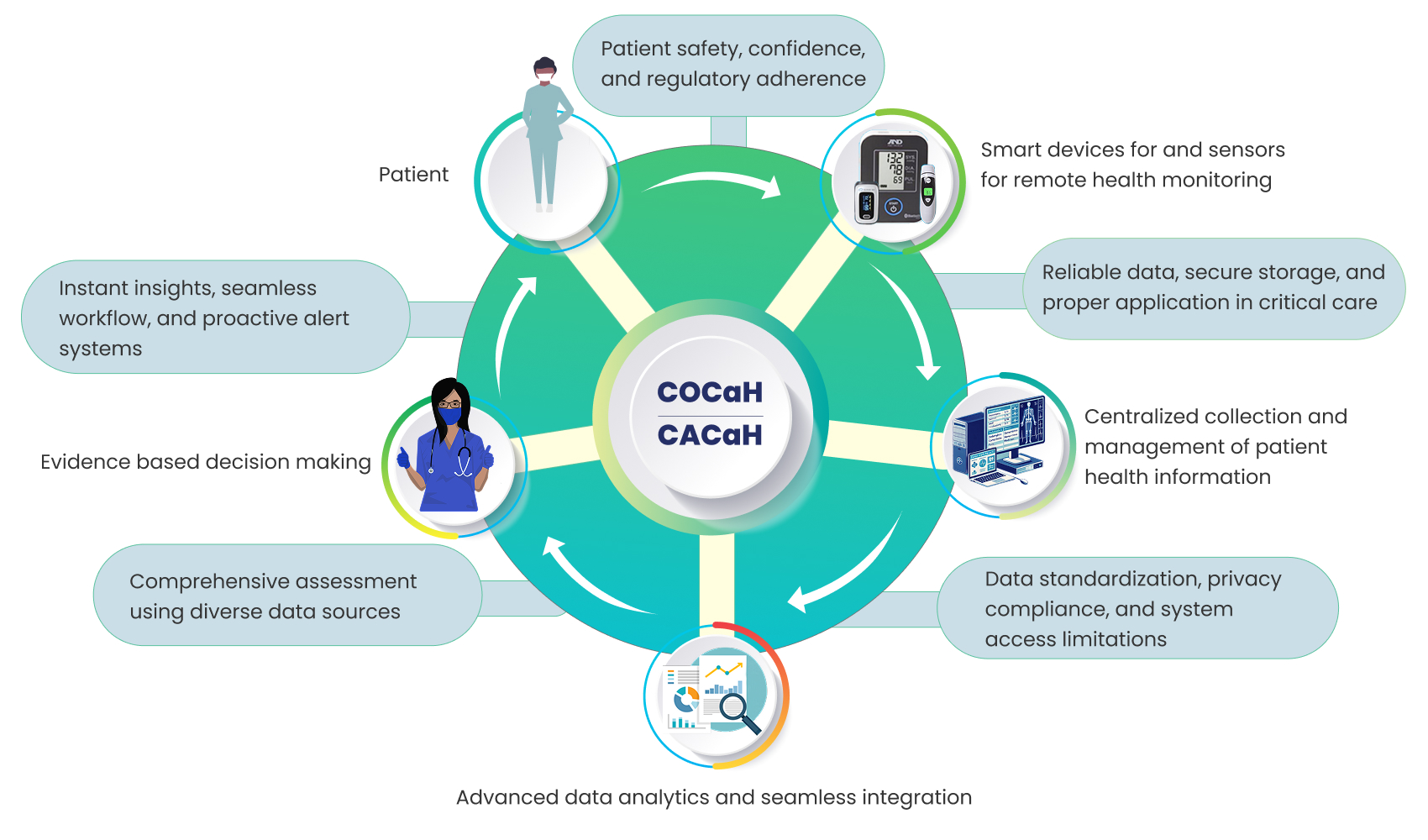
The data lifecycle in a next-generation Hospital-at-Home model, highlighting both practical and technological challenges for widespread adoption. Multimodal patient data is collected, analyzed, integrated, and interpreted to enable the delivery of acute-level care within the home setting.
Key Differentiators of COCaH/CACaH
- Extended Care Beyond Hospital-at-Home: While HaH provides short-term hospital-equivalent care at home, COCaH/CACaH offers long-term, proactive health management for chronic conditions.
- AI-Driven Early Interventions: Predictive analytics help detect deterioration before hospitalization is required.
- Comprehensive Home-Based Services: Includes remote monitoring, mobile diagnostics, telehealth consultations, and home-based interventions.
- Patient-Centered Model: Patients receive tailored interventions aligned with their health conditions, lifestyle, and preferences.
- Family & Caregiver Involvement: Patients and their caregivers receive training and support, ensuring they can confidently manage health conditions at home.
Implementation Strategy for COCaH/CACaH
Patient Eligibility and Enrollment
COCaH/CACaH is ideal for patients with chronic, complex conditions such as:
- Heart failure, COPD, and diabetes
- Post-surgical recovery and rehabilitation
- Neurological disorders like Parkinson’s and Alzheimer’s
- Oncology patients needing at-home chemotherapy or palliative care
- Behavioral health patients requiring continuous virtual therapy
Key Components of COCaH/CACaH
- Remote Patient Monitoring (RPM) & AI-Driven Insights
- Wearable sensors for continuous health tracking (BP cuffs, ECG patches, CGMs).
- AI algorithms analyze data trends and predict deteriorations.
- Automated alerts for care teams to intervene early.
- Telehealth & Virtual Care
- 24/7 provider access via HIPAA-compliant video calls.
- AI-driven transcription and summarization of virtual visits.
- Smart scheduling and reminders integrated with patient data.
- Home-Based Diagnostics & Procedures
- Mobile lab draws, imaging (ultrasound, X-rays) at home.
- Home infusion therapy (IV antibiotics, chemotherapy, hydration).
- Remote rehabilitation programs with AI-assisted monitoring.
- AI-Augmented Care Coordination
- Automated task assignments for home care nurses and paramedics.
- Integration with electronic health records (EHRs) for seamless data exchange.
- Chatbots for medication reminders, symptom triage, and patient support.
- Family & Caregiver Support
- Caregiver training for using home-based medical equipment.
- Regular communication between care teams, patients, and families.
- Emergency support for escalating health concerns.
- Social & Behavioral Support Services
- Virtual counseling and psychiatric support.
- AI-based risk assessments for social determinants of health (SDOH).
- Home-based palliative and hospice care for end-of-life support.
Business and Financial Model
COCaH/CACaH aligns with value-based care principles, focusing on reducing costs while improving outcomes. Potential revenue models include:
- Medicare Advantage & ACOs: Capitated payments for managing at-risk populations.
- Hospital Partnerships: Expanding existing HaH programs for post-acute care.
- Commercial Insurance & Employers: Bundled payments for chronic disease management.
- Direct-to-Consumer Subscriptions: Hybrid concierge care models combining virtual and in-person services.
The Role of Technology in Scaling COCaH/CACaH
Instead of building costly custom EHRs, leveraging platforms like Microsoft 365 or Google Workspace enables a rapid, cost-effective rollout of COCaH/CACaH solutions.
Core Technology Infrastructure
| Feature | Microsoft 365 | Google Workspace |
|---|---|---|
| Productivity Suite | Teams, OneDrive, SharePoint | Gmail, Google Drive, Docs |
| Low-Code Development | Power Apps, Power Automate | AppSheet, Apps Script |
| AI & Data Analytics | Azure AI, Power BI | Google AI, BigQuery |
| Telehealth | Microsoft Teams | Google Meet |
| EHR Integration | FHIR API connectors | Google Cloud Healthcare API |
| Compliance | HIPAA, HITRUST, FedRAMP | HIPAA, HITRUST, FedRAMP |
Conclusion: The Future of Home-Based Healthcare
COCaH/CACaH represents a game-changing shift in non-hospital care. By integrating AI, remote patient monitoring, home-based interventions, and virtual care coordination, this model reduces hospitalizations, enhances patient outcomes, and significantly lowers healthcare costs.
By incorporating insights from Hospital at Home, COCaH/CACaH expands on short-term acute care solutions to provide a long-term, patient-focused approach, ensuring continuity of care beyond hospital walls. This hybrid model of proactive, technology-driven home healthcare is paving the way for a more sustainable, accessible, and cost-effective healthcare system.
Key Takeaways
- COCaH/CACaH builds on the Hospital-at-Home model, offering long-term, proactive care beyond acute treatment episodes.
- AI and remote patient monitoring drive early interventions, reducing hospital admissions.
- Family and caregiver involvement is crucial, ensuring patients receive comprehensive home-based support.
- Leveraging existing technology platforms (Microsoft 365, Google Workspace) enables rapid deployment without costly custom EHR development.
- A value-based care model makes COCaH/CACaH financially sustainable while improving patient outcomes.
- The future of healthcare is shifting from hospital-centric to patient-centric, making home the new center for continuous, high-quality care.